How to Choose the Right Type of Acrylic Glazing Learn how to choose the right type of acrylic for your framing project, as well as how to care for and clean it, and how it differs from glass.
Acrylic is a lighter-weight, shatter-resistant alternative to glass frame glazing. (Glazing is the generic term for the glass or acrylic used to cover and protect the image.) Acrylic glazing comes in a variety of finishes to protect your framed art and photos and is ideal for large framing projects. Acrylic is prone to scratching, however, and requires careful handling when framing and cleaning.
Standard Acrylic
Standard acrylic has no coatings, no matte finish, and no tint. It is translucent and optically pure. Acrylic is more optically pure than glass except for the very expensive low iron glass sometimes referred to as Water White. Regular glass has a green tint, which is readily visible if you place a piece of glass on white printer paper. Standard acrylic is probably fine if your print is standard photographic print process or archival inkjet, if you do not need it to last past 10 years, or if you are not displaying it in direct sunlight. If the print is a standard inkjet print and it's not being sold, then standard acrylic should be fine because the image can be reprinted.
UV Filter Acrylic
UV filter acrylic blocks up to 99% of Ultraviolet (UV) radiation. This helps reduce fading on all types of photos in picture frames. UV filter acrylic has a slight yellow tint which can create a minor warming effect. Slight tint means that it has approximately half the tint of glass. If you do not notice the green tint on the picture frames in your house, you will not notice the yellow tint in UV filter acrylic. Consider UV filter acrylic if you will be displaying your photo frame in a brightly lit room, or if you need the photograph to last past 10 years. (Note: 10 years is a conservative number.) Standard photographs can last longer than 10 years with very little fading depending on the type of light in which they are displayed. It also depends on how much fading you can tolerate. A photograph can still fade with UV filter acrylic unless it's kept in darkness.
Non-Glare Acrylic
Non-glare acrylic has a matte finish on one side to reduce the glare from light. Some non-glare acrylic will cause a noticeable loss of sharpness even if it is against the print. This high quality product causes only a minute loss in sharpness, even with a thick 8-ply mat. With 4-ply mat you will need a loupe to detect the loss of sharpness. This version of non-glare does not have any UV-filtering making it optically pure (no tint). Non-glare will not completely eliminate the glare of light, but will reduce it considerably and make the picture frame much more presentable in poor lighting conditions. The drawbacks are higher cost and a possible slight loss of sharpness. The best way to display an image is with standard or UV acrylic and proper lighting so that no glare is created.
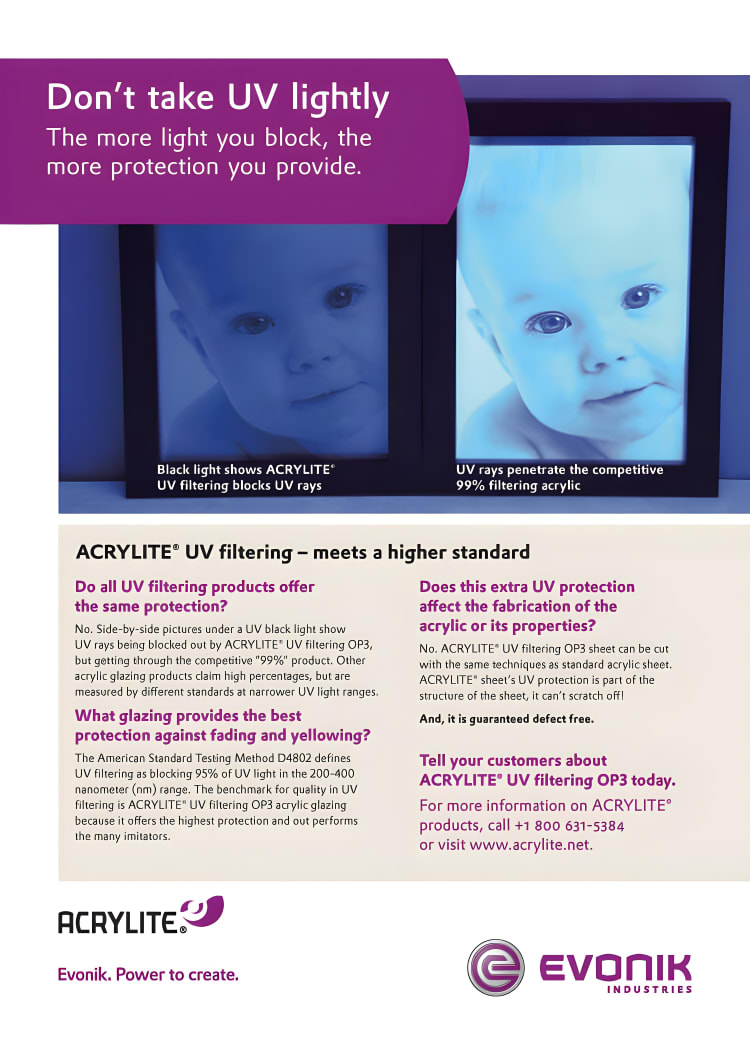
ACRYLITE® UV filtering (OP3) acrylic products offers museum-quality UV protection, and the beautiful clarity of the finest picture frame glazing, without the heaviness or breakability. It is a safer alternative at half the weight of glass, many times more resistant to impact, easier to handle, and more economical to ship.
ACRYLITE® UV filtering acrylic offers the highest protection from the irreversible effects of UV damage. It protects from both natural and artificial light, protecting paper-borne artwork, prints and documents from fading, yellowing and brittling. ACRYLITE® sheet's UV protection is part of the structure of the sheet, it can’t scratch off!